The Game Mage

Documenting one mage's journey to follow his dream and die trying

So I Founded a Game Studio?

Inscribed on

Hi. Welcome. Hungry? You look hungry. Have some soup. This might be a long one.

You know how sometimes people be like, “I wish I could do a thing,” and then they spend their whole life doing anything but that?

I regret to inform you that’s extremely not my vibe. I do the whole thing. With my entire chest. All the time.

So I founded a game studio. Did you know you can just do things? You can totally just do things. But what does “found a studio” even mean? Technically I could file a couple bucks worth of paperwork and “found” just about anything. Ask the guy who “ran” a “restaurant” out of his back yard that sold frozen pizzas.

In The Beginning… Actually no, I’m not doing this joke again. I’ve done this joke too many times.

TomeSpire Games is two people, me and my fiancé (who we will call Ash). I’m doing 80% of the business development and 20% of the game design. He’s doing 80% of the game development and 20% of the game design. My hope is eventually that shifts and I’m more like 50/50. But for now, we do what needs must.

I’d figured out the name about a year ago. Indeed, the domain registration renewed during our first sprint. Email had been working for a while, just for me, hanging off my existing Fastmail subscription. I needed it to work when I registered for GDC2026. The website followed only shortly before GDC.

Just enough of a web presence that if someone googled me after a round of Speed Networking, it would look like there was an actual (if small) studio, and not just a wizard who is actually three moths in a trench coat.

But we actually started working on it in earnest around January or February. Ash was working a low-paid dead-end IT job for a state university, and came home after a particularly frustrating day with a simple request. He wanted to quit. At the time, I thought, well okay no obviously that can’t happen. Then I started to think, okay, but what if…? The money he was bringing home mostly paid for his gas to get there, the lunches he bought, and some fun money for him. In addition to that (and everything else we do), he runs a successful online card shop for Magic: The Gathering.

All of which is to say, I started to think, maybe we could consolidate a few things and make the economics work. And since this isn’t really a post about our family design, I’ll skip how we pulled that off and simply get to the good part. That’s what we did, and so as a result Ash now works from home as the studio’s unpaid intern.

On The Clicking of Buttons

In case you ever decide to start a company and don’t already know this, here are a few important notes:

  1. Get the company its own bank account. Transfer in some money from yourself. Treat that as the company’s from that point forward. This is important and future-you-trying-to-do-taxes will thank now-you for it.

  2. Make new accounts for the company. There may be stuff you started before you formally created a company. For example, I had been sitting on the TomeSpire domains, but I needed to get those out of my personal registrar account and into one owned by the company.

  3. Figure out your marketing pipeline early. Lots of good stuff gets made that nobody ever finds out about. We’ve decided to use Itch as our top-of-funnel discovery platform and a one-two punch of Email and Discord as our notification vehicles. No social media, because I don’t think it works and I’m not good at it. If we’re ever fortunate to hire someone who is good at it, then they can revisit that stance.

Prototype 1

If you’ll allow me a brief aside. You will? Thank you. Have some more soup.

There’s a trap that lots of first-time game creators fall into, which is they decide their First Game is going to be their Forever Game.

Don’t do this. It almost never works. And the two or three people it has worked for are Survivorship Bias. We don’t tell the stories of the hundreds or thousands who never shipped, because we’ve never heard of them.

So we’re starting with a series of prototypes. The goal is roughly one per quarter for probably the next two years. Because we want to get our name out there as a maker of Weird Stuff, and because we have a lot to learn, and because it increases our surface area of luck.

If one happens to really “click,” then we’ll look into developing it into a full game. But, weirdly, that’s not actually the goal. Prototypes now. Game later.

We kicked around probably 10-20 ideas for what our first prototype could be. Almost all of them are sitting in the idea bank for future development. I still like the idea of a haunted mainframe that wants to steal your soul. I also like the one that’s a puzzle game where you’re trying to break out of a dungeon instead of in. Also did I ever tell you about my game idea where the internet is Pokemon? The internet is Pokemon.

The winner for this cycle could best be described as “what if Stardew Valley was an incremental game?”

Incrementals are interesting, but they’re also good candidates because they’re often not graphically or technically complex. It’s more about the interaction of systems and the loop you can build out of that, than trying to push graphical fidelity. A good incremental says a lot more about the developer’s ability to execute on an idea than their technical fundamentals. In short, it’s a perfect candidate for learning a new technology stack. Which we are.

The last time I worked in video games we were building on the Wolf3d engine. This is Ash’s first game.

Okay So What Did We Actually Get Done?

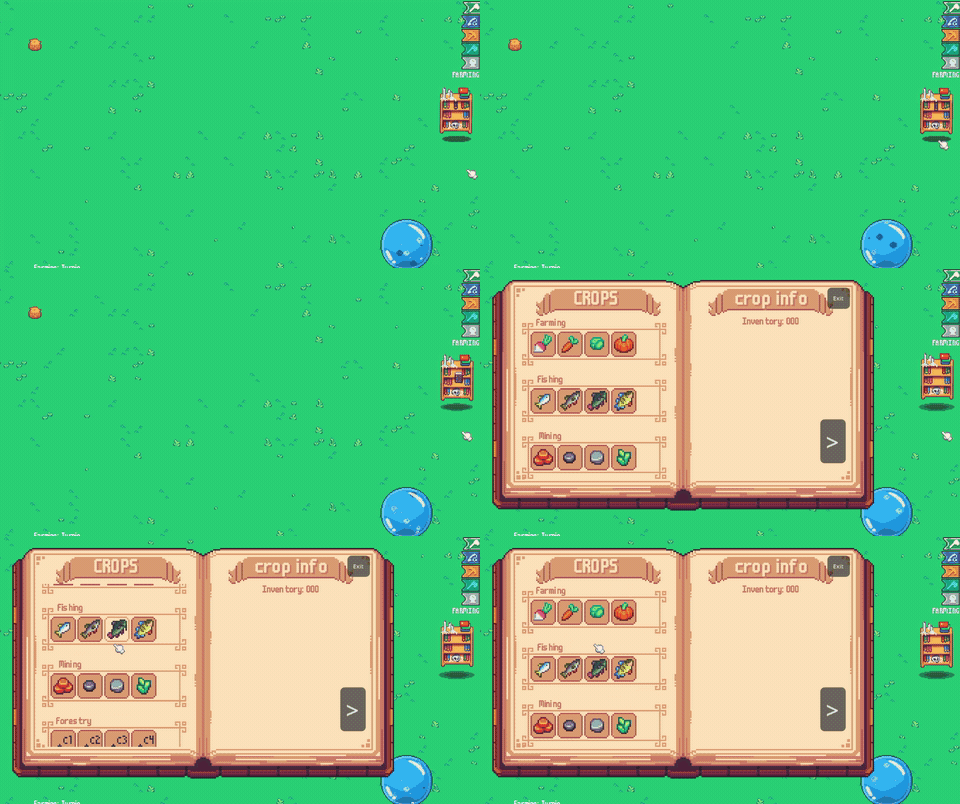
A pixel art-style farming game screen shows a small farm area with various crops, a pond, and different tool icons at the bottom.

Prototype 1, Sprint 1

This is going to be a bit of a punch list:

  • We got our dirty paws on some assets. Ash is a good pixel artist, but having to do all the art from scratch, plus build the game, plus everything else is a lot for one person. Buying some baseline assets (with the company card!) allows us to execute faster on the vision.
  • We made crops grow. This might seem silly, but if you’re going to have crops, figuring out how to get them to grow over time, how to get the right image to display when they do? These are the pieces from which a game system is built.
  • We made tools. Let there be a watering can, and let it sprinkle, and we saw that it was good.
  • We made a tiled plot system, so that you could plant crops in specific places, and then we made it so that they could be unlocked. One of the key game loops in most incremental games is getting resource to unlock more thing so that you can get more resource to unlock more thing and so on and so forth.
  • We made it rain. Both literally and figuratively. From the watering can and the sky, with effects on how the crops grow.
  • We made it look a little prettier. For the screenshot. We probably shouldn’t have, but it’s our first screenshot and we’re proud of it.

Not bad for like, nine days, right?

In a traditional sprint retro usually we’d talk about three things. What went well, what didn’t, and what we might want to change next time. Sometimes this is called “start, stop, keep.” But we’re an extremely nontraditional company run by an extremely nontraditional internet soup wizard.

We will instead be doing stuff we wish we’d known, notes to future us, and what we think is coming next.

The Broth, or The Foundation of Things, or What Would I Want To Have Known Before This Sprint If I Could Have Known Them

  • We’re using YouTrack as our planning tool. I like JetBrains. It’s pretty good. But it’s also very Not Jira. Coming from a mostly-Jira background, I’ve had to rapidly learn and adapt to a surprisingly different take on how a tool like this should work.
  • Did you know the CAN-SPAM act requires the sender of the email to put a physical mailing address in the email? Me either, but I do now. If I had known I was going to need an address for the studio that wasn’t my address, I would have started the process of getting one earlier. (To be fair, I knew we’d need this eventually, but wanted to put it off as long as possible).

The Bread, or The Accoutrements, or Other Things That Go On The Side And Are Also Good Maybe But Aren’t Really A Meal On Their Own

  • Having good idea capture hygiene is really important in a creative company. This is a pipeline I’m still working on, and probably will be forever, but lots of good ideas pop up that aren’t right for this prototype but may be for the next.

The … Look I Couldn’t Find A B-Food-Word That Worked Here, or The Things Coming Next, or That Which I Naively Believe We Might Actually Be Talking About Next Time

  • We have honest-to-goodness research tickets in the next sprint covering basic engine functionality. Stuff we’ve realized we just plain need to understand better if we want to be able to use it. Making games is hard y’all.
  • Starting in on the currency system. There needs to be a thing you can sell crops for, and a thing you can use to buy upgrades, and we need a currency to be able to test that.

That’s it. Soup’s done. See you next sprint.

Let’s Try

Inscribed on

On July 2nd at 10:33 Bruce Straley, director of Uncharted 2 and The Last of Us, received an email.

Subject: RE: Notice of Termination

Chapter 1

I went to GDC 2026 last week. This is notable for many reasons, not least of which: I am not currently a game developer. And in fact have not been for roughly 20 years.

Oh, sure. I’ve got a pile of hobby games deep enough that the cats sometimes get lost in it. I’ve written a MUD in just about every language it’s possible to do that in. And also some where it isn’t.

But nothing that’s ever seen commercial release. Most of them haven’t even been played by other people.

So like, why spend the cost of a Disney World vacation to go to a trade show for an industry I’m not involved in?

Because, dear reader, I was trying to figure out if maybe I shouldn’t be. I was looking for my tribe. I wanted to know if I would belong.

But if I’m being honest, by the time I boarded the plane to GDC, I already knew. I wasn’t at GDC to figure out if I should make games. I was at GDC because I can’t not.

Chapter 2

One of the interesting things about attending GDC as a relative outsider trying to find their place is that there’s no “obvious” set of sessions to attend. If I were showing up as a technical artist, then great, attend all the sessions on technical art. Looking for a publisher? Talk to lots of publishers.

GDC does a great job of providing paved paths where paths make sense.

But I was there for the tasting platter. The smorgasbord. I went to every session that seemed even remotely interesting or relevant.

I listened to Owlcat Games talk about their Etudes system for highly-branched narrative design.

I listened to Outersloth talk about indie game funding.

I listened as developers big and small talked about the tiny games they made in their free time when they weren’t making bigger games. Because they, too, have a spleen demon that compels them to create.

The only thread that tied it all together is that each and every session was interesting. And in almost every case I had traded off one if not two other equally-enticing sessions to be in the room.

Chapter 3

Here’s the thing. I never once heard anyone say it was easy. Quite the opposite. There was broad agreement that making games is hard. This is a field no sane person would ever enter. Except we feel compelled to do it for reasons beyond even our own understanding.

To abuse a line an old professor of mine once tossed out: if you want an easy job that pays well, go into finance. Everyone else has to work for a living.

I’ve spent the last 20+ years trying to run away from video games, because my first professional experience was wildly negative, and I was young, and I didn’t understand that one bad job is just a bad job, and that it wouldn’t change what I was passionate about.

When I booked my tickets to GDC it was because I wanted to prove out the idea of a pivot to Video Games. I’m middle aged! By traditional wisdom it’s getting kind of late to start a new career!

What I found was room after room of people that would sagely nod that they had unwisely chosen to do this difficult, impossible thing. And would do it again. Every time.

Towards the end of the week I ended up at a talk titled: From a Naughty Dog to a Wildflower: The Fears, Failures, and Freedoms Found because I was interested in the founding-an-indie-studio part. Boy was I in for a surprise.

Chapter 4

Bruce Straley spent 18 years at Naughty Dog, making several highly acclaimed video games. You may even have heard of them.

He left in 2017 because he felt like he’d done what he needed to do. Said what he needed to say. The challenges no longer felt challenging.

And then his spleen demon (my words, not his) rose up and said, “Hey. Buddy. You didn’t really think you were going to retire did ya?” (In my head his spleen demon, as is traditional, has a vaguely unplaceable but roughly New Jersey-esque accent.)

So he started Wildflower Interactive. There’s much about that journey I’m not qualified to tell, and I’m just roughly paraphrasing what he said during his GDC talk on his career journey from Naughty Dog to Wildflower. But things did not entirely go as he had hoped.

Wildflower’s publisher required milestone deliverables every three months. In practice, that meant roughly a week and a half shoring up the deliverables and a week and a half postmortem after. Basically one month out of every three spent not trying to find the fun. A quarter of the year not making the game.

Eventually, disputes over the staggering of releases would lead to a strained relationship with the publisher. Every milestone was a showdown. Deliver, or give the publisher their chance to cancel.

Eventually, they canceled anyway.

Subject: RE: Notice of Termination

But Wildflower’s legal team had been smart. Cancellation for convenience meant that the publisher needed to pay out. And that meant Wildflower had runway. And a new problem.

Straley had three choices:

  1. Keep the full team and fix the game.
  2. Reduce the team and rescope the game.
  3. Close the studio.

The problem with option #1 is that runway only lasts so long, and he didn’t think they had enough runway to deliver the game as they originally imagined it.

The problem with option #3 is Straley seems like a genuinely good guy. He could have taken the money and run. It would have been completely legal to throw in the towel.

So he made the hard choice. He picked option #2. They laid some staff off, they reimagined what that game could be, and they soldiered on.

Chapter 5

Wildflower’s remaining staff had a rough road ahead. If you’ve ever had to take ownership for someone else’s code, you know how hard it can be to figure out what they were trying to do.

Hell is someone else’s implementation.

They cut away the parts of the game that weren’t working, while worrying whether the studio was even going to make it.

Three months into rebuilding the game, Straley asked if a problem was solvable. He expected resistance. He expected no.

“That’s just a knob. I’ll tweak a variable.”

The team had survived the trial by fire, turned the corner, and were capable of moving forward.

All of this led Straley to a line that will live rent free in my head for the rest of my life. I might even get it tattooed.

“Stick your chest out and go like — fuck it. Let’s try." - Bruce Straley, GDC 2026

The whole reason I was at GDC in the first place was to answer a question. Should I found an indie game studio?

Fuck it. Let’s try.

Blogwagon: Contrariwise’s Rule of Three

Inscribed on

I don’t know that it got as much traction as it probably deserved, but Sam Seer asked us to talk about three games that were important to us, and I thought. Yes. Yes I think I will.

A Tale in the Desert

I am not physically capable of being reasonable about A Tale in the Desert. This is my ur-game. This is the game that I literally cannot be allowed to play, because it would consume me whole.

It would take me into its bosom and I would be unmade.

My first encounter with ATITD was through the IRC channel of another game (for another time). A friend said, “hey, this sounds like your jam.” And it was. It extremely was.

This was back during their open beta, but the way an ATITD beta worked was that they’d reset the game and make it available to play for a weekend. Dear reader, I would orient my entire life around maximizing that weekend. I would do nothing else. It was my everything.

Eventually they launched into “Tale 1.” If you didn’t read the Wikipedia link (no judgement,) it’s important to know that ATITD operated in “tales.” Each tale would begin with a fresh world, with slightly modified systems, and progress through to a complete ending, before starting anew.

Originally, these tales were designed to last a year. Most of them have ran significantly longer.

The first tale I was able to play, as a paying customer, was Tale 3. I participated in the beta for Tale 2, and I think I played in Tale 4 as well. But that was around the time I went back to college as an adult, and realized that I simply couldn’t be allowed to continue playing.

So I shut the door and have never allowed myself to turn the key. Because I know that on the other side are all the horror stories of someone who couldn’t disconnect from an MMO until there was nothing left.

That would be me, and I know it with my entire self.

Exalted (1e)

I didn’t have a lot of access to TTRPG sourcebooks as a youth. Some time in middle school I got my filthy paws on a copy of AD&D, and that lead to no end of trouble at home for bringing the “devil magic” into our home.

Fast forward a few years to high school, and I had a small amount of money burning a hole in my pocket which I had decided to spend on either Cyberpunk or Shadowrun. I can’t remember which. But I had been eyeing it at my local Borders for some time.

Except when I got there, it was gone. But what I saw in its place, which would go on to inform most of my own tastes and opinions about RPGs far in excess of anything D&D achieved, was Exalted.

The original first edition solars book. Which probably had only just come out.

It was entirely unlike anything I had encountered before. A wildly imaginative wuxia-inspired TTRPG setting with godlike powers, grand destinies, evocative mysteries, and enough ideas to fill every campaign world I would ever go on to write.

Something I didn’t know at the time but now deeply appreciate is that each of the Exalted 1e core rulebooks has an unreliable narrator. The history of the world, how they got where they are, who is to blame, is always written from the perspective of the faction whose book you are reading.

And so, over the course of roughly eight of them, it’s possible to figure out what really happened. Which set an example for world building that I aspire to live up to.

I didn’t know it at the time, but I managed to organically collect almost every book that came out for first edition. I would later have to sell them all to make ends meet, but one of the first things I did once I was financially stable was track down and complete the collection, and the entire run of Exalted 1e has place of pride on my bookshelf to this day.

Earthdawn

For everything that Exalted is, Earthdawn probably should have been. It is the first TTRPG I ever encountered in the wild. Before I found D&D, a friend let me borrow their copy of the Earthdawn core rulebook.

I think if I had found it slightly later, or in a position where I could have purchased more of its materials, it might have taken off more in my imagination. As it stands, this is the book that gave me a fascination with airships. And its particular rendition of “blood magic” (trading permanent stat debuffs for ongoing magical effects.)

Many years later I would come to find out that much as Exalted was intended to be the “backstory” for the World of Darkness, Earthdawn is meant to be the “backstory” for Shadowrun.

Exalted quickly grew into something very much its own, and in no way ties into the rest of the WoD. You can still find evidence that this was the original plan, including in the advertising copy on Amazon.com.

You’ve Heard the Rumors.

Before the Impergium before the Mythic Ages before the Sundering before there was a World of Darkness there was something else. And now it is revealed, at last. Come adventure in the Second Age of the World, the fantastic world of the Exalted.

Now Play the Game.

Though thematically related to the modern-day World of Darkness, Exalted begins a whole new line of fantasy products from White Wolf. This hardcover rulebook invites you to become one of the Exalted, an heir to an Age of Heroes. Created to be saviors and Prometheans to humanity, the first Exalted were corrupted and slain by their own brethren. But now, new Exalted are being reborn into the Second Age of the World. Can you survive in a world that needs you yet reviles you? The fate of this new world is in your hands.

Though as far as I understand, Earthdawn is still nominally the background explanation for the world that would eventually become Shadowrun. Both games are somewhat famously considered “unplayable” by modern standards. At least in their original editions. There’s a great deal of interesting concepts in them, but mechanically they didn’t work.

And, so…

One of the through lines for all three of these games is that they are the origin story for concepts that continue to repeat in every creative endeavor I’ve undertaken since. I’ve built MUDs that are basically ATITD. I’ve written campaign worlds that are basically Exalted. My friends and I dreamed through most of high school of making an MMO about airships that had Earthdawn as its beating heart.

Over time I’ve continued to refine the parts of these ideas I like the most, adapt them into something new. My campaign worlds look a lot less like Exalted with the serial numbers filed off. But if you know where to look, you can still find the marks they left on the person I would someday become.

Inscribed on

Half-tempted to write a massively distributed roll-and-write wargame to be played by All of PAX.

Insane? Yes, absolutely.

When has that stopped me before?

PAX Unplugged 2025 - PAX Metro: The Underground Expedition

Inscribed on

For those of you who were at PAX Unplugged you may have encountered the Line Entertainment team. And if you found us at night, you may have been presented with the opportunity to participate in the Grand Campaign - a distributed adventure narrative told over the course of the weekend.

As each story beat progressed attendees were presented with the current situation and a variety of options, each with a custom Difficulty Check (DC) attached. Rolling on the giant inflatable d20 and passing the DC added a vote to the attendee’s preferred narrative path. The accumulation of votes determined the path the story took.

Presented below is the narrative we created. More details will be forthcoming in a later Postmortem post.

The Descent

Your expedition team stands at the entrance to Service Tunnel 404, deep beneath PAX Metro. The air is thick with moisture and strange, chittering sounds echo from below. Your guide points to three possible routes deeper into the metro system, each leading into darkness.

🔹 Follow the Main Service Rails
It’s the official route, but also where the missing crews were last seen.
1 vote

🔹 Wade Through the Flooded Lower Level
Knee-deep water glows faintly with bioluminescent algae. It’s a shortcut, but you’ll be walking blind through an unknown ecosystem.
3 votesCHOSEN

🔹 Climb Through the Ventilation System
The metal grating overhead leads to the air ducts. Risky and noisy, but you’ll see everything below before committing.
1 vote

Bioluminescent Gardens

The flooded tunnels have become an underwater forest. Glowing algae creates an ethereal blue-green light, schools of translucent fish dart between submerged platforms, and the water hums with life. But larger shapes move in the deeper channels ahead.

🔹 Follow the Water Source
Trace the clean, flowing current upstream to see what’s feeding this thriving ecosystem.
5 votes

🔹 Investigate the Far Tunnel
Head toward a side passage where the bioluminescence seems brightest and most concentrated.
15 votesCHOSEN

🔹 Approach the Large Shapes
Wade toward the massive forms moving in the deeper water - they could be debris, vehicles, or something alive.
13 votes

The Hidden Passage

Behind concealed maintenance doors marked with symbols that predate the metro, you’ve found passages that lead to the true heart of this underground world. The architecture here is older, more purposeful - this was built to be hidden.

🔹 Commit to the Hidden World
Cross the threshold into whatever lies beyond. There may be no going back to the surface world as you knew it.
10 votesCHOSEN

Guardians of the Deep

You’ve become protectors of the underground ecosystem, working alongside the enhanced wildlife to maintain the delicate balance between the surface metro and the hidden world below. The creatures accept you as allies, and you’ve found a new purpose in bridging two worlds that were always meant to coexist.


You may notice The Hidden Passage had only one way through. This is a design mistake that I’ll talk more about when I follow up with the LimeTools Postmortem.

Dune 2: Even More Dune

Inscribed on

“It sounds like you might be playing the ghost of a better game that lives inside this one.” – Claude Sonnet 4

Previously: Waking Up to Dune Awakening

Part 1: How Stella Got Her Groove Back, or, When The Worm Lost its Teeth

Okay, so. Uh. I’m still playing Dune: Awakening.

Yeah, I also think that’s weird.

I’ve never spent so many words explaining why I don’t recommend something only to go on and keep engaging with it. Usually I’d call it good and walk away. But there’s something here in the dark heart of Arakkis that keeps me engaged, and now I’m going to spend the next however many thousand words trying to find it.

The first time I got eaten by the worm, it took everything I had. The next five to ten hours of game time was rebuilding lost ground. There’s equipment I had that I never replaced. It sucked. And I think it sucked even more because the game really wants you to make exactly the series of mistakes I made. It doesn’t tell you that you have to, but it definitely encourages it.

But the thing is, once you’ve got a base established in the second area (whose name I never remember. Let’s call it The Gap.) Once you’ve got a base established in The Gap, it’s actually super easy to get back and forth between the first area (hereafter called The Basin) and The Gap.

Run to the nearest outpost, spend a small amount of in-game currency, fly on down. Which meant I could also head back to the now-simpler enemies of the Basin and grind for resources, for recipes. Things that had been hard to come by in hour 10 had become trivial.

Somewhere around hour 30 I realized that I no longer feared the worm, because the limit of the damage it can cause me is what I happen to be carrying at any given time, and that’s a passing fraction of what I’ve stockpiled in my base. It’s slowly transformed from a catastrophic “lose everything” event to a mild inconvenience where I’d have to spend 15 minutes recrafting some gear. All the resources I need are in chests at home.

Slowly, I was beginning to master desert power.

Part 2: Shop Smart. Shop S-Mart.

This is not my original observation, but I forget where I saw it first: Dune: Awakening is a game of eras. Foot power, buggy power, and sky power.

This is my original observation: It’s actually worse than that. Every region of the desert is its own S-Curve.

This is an S-Curve:

It takes a while to get going, then suddenly it goes up a lot, then it stalls out at the top.

You start the game with nothing and are quickly taught to make scavenged weapons and tissue paper armor. It takes most players 10-20 hours to get out of the Basin, over which you upgrade to your first real weapons and armor. The enemies go from being able to nearly instantly kill you to pretty easy to overcome.

Then, you head to the next area and the really cool gear you arrived with SUCKS! You’re back at the bottom of a new S-Curve! And the cycle repeats, once again climbing the local regional violence economy.

But that also means every new area is a transition from feeling competent, of having mastery, to once again being at the bottom of the food chain. The ideal game usually has a much smoother difficulty curve, where you feel like you’re getting better the entire time you play. In Dune: Awakening, you’re continually being kicked back to the bottom of the curve.

As I master the area I’m in, it becomes easy and fun. It’s even more fun to go back to a previous area and absolutely wreck it. But there’s no way to carry that into the next area. No matter how good I’ve gotten, I’m limited by resource access to the current tier of gear and weapons, which won’t prepare me for what comes next.

Part 3: Hostile Teaching Methods and Other Pedagogy

Over time what I’ve realized is that the core problem is one of communication. The game fails repeatedly to communicate.

Case in point: there are basically two kinds of enemies in Dune. Shooters and stabbers. Shooters hang back and try to gun at you. Stabbers try to get close and poke you with their sharp pokers.

In the tutorial the game introduces the concept of a “dash.” Press alt, assuming you’re using the default keyboard map, and you’ll dash in the direction of your movement keys. Do it three times to prove you can. Never mentions it again.

Dash is the single most important thing the tutorial ever teaches you, and it spends about 30 seconds on it.

Dash is the thing that lets you escape when the AI gangs up on you. Dash is the thing that lets you not get stabbed to death by shield-wearing raiders. Dash is fundamental, critical, life-giving. For being so fundamental to the balance and design of combat, it sure is a shame that you never need to dash away from any of the enemies in the Basin.

You see, the game teaches you the basic combat inputs under pressure. You’ve got the classic tutorial unkillable enemy that just keeps coming at you until you correctly input the dash command three times. But then it sets you loose in The Basin, an easier-than-the-rest-of-the-game semi-tutorial where the AI is tuned down to make worse decisions and be easier to kill, and does not in any way reflect the complexity of future AI combat decisions.

So it’s real easy to forget about dash. Or think you don’t need it. Because you won’t, for about the next 20 hours. Better hope you remember how to do that when you get to The Gap and it becomes the only way to survive.

Better design here would have looked like enemies in The Basin using the full capabilities of the AI, who behaved like future enemies, but with downtuned damage and HP. Better to have an enemy you still need to dash away from who mostly isn’t that dangerous when you get it wrong than an enemy that stands there and lets you murder them until the difficulty ranks up.

Part 4: Games Should Be Fun The Entire Time You’re Playing Them

Dune: Awakening is a game about taking risks. Also about the planet trying to kill you. Also worms. (Which are trying to kill you.)

I’m a conservative and loss-avoidant player.

These shouldn’t mix. And mostly don’t.

Here’s the thing, I have aggressive goals in life which mean, among many other things, that I get to play maybe two or three hours of video games a week, on average. Often less. Which also means I do not have the luxury of being able to start over.

Starting over is catastrophic. Starting over means you’re now competing for my heart and mind with starting fresh. The opportunity cost of playing the same hour of a game twice is an hour of another game I’ll never get to play. It’s a high bar under the best of circumstances.

What this means is that I generally play games in a way that minimizes my downside risk. If you make me choose between doing the same one-hour task twice, with a 50% chance of success, or doing a two-hour grind once, with a 100% chance of success, I will always do the two-hour grind. As long as I enjoy the process of the grind.

Some designers would call this “optimizing the fun out of the game.” Because they have decided that fun means playing it a certain way. And that’s cool, I guess, that they know me so well that they can describe with authority whether or not I’m having fun.

But here’s another thing: you don’t pay my sub.

At a certain point if players aren’t playing the way you intended, you need to consider that they’re rational agents making decisions under pressure. Maybe it’s not as fun as you think it is.

Part 5: Nobody Wants PvP, Funcom

Dune wants to be EVE: Online so bad. Like so, so bad. By which I mean the “drain” in this sink-and-drain economy was clearly meant to be end-game PvP. Everything is in service of end-game PvP. Every little system, every weird decision, it’s all there to support the Deep Desert and the War of Assassins between Harkonnen and Atreides.

Except nobody wants it.

How do I know that?

Evidence the One - Faction demographics. There are two factions you can choose, and in fact you are forced to pick between. Atreides or Harkonnen. The Atreides faction gets buffs to building stuff and working together. The Harkonnen faction gets buffs to PvP.

Atreides outnumbers Harkonnen 14:1. (I really wish I could find my source on this. You’ll have to take my word for it. At least as of the time of writing it’s pretty easy to find threads of people complaining about the clear faction disparity but many of them are unlinkable for a variety of “people being awful to each other on the internet” reasons. So, your Google may vary.)

Evidence the Two - Dune launched with an all-PvP endgame, which the first two content patches immediately reversed.

I suspect they did this primarily because they really wanted Dune to be a Live Service game. If you have a Live Service hit, you have a license to print money.

Notably, not because the game is better this way.

In fact, I’d argue it would have been a lot better as a single player experience.

The clear antagonist of Dune is the desert itself. A harsh, unforgiving desert, with giant sandstorms and hostile fauna. A single-player Dune game could have told a deeply compelling story about learning to survive and ultimately thrive in the hostile environment.

But compelling stories have narrative conclusions and conclusions don’t convince you to spend money in the cash shop.

Part 6: Okay, So Why Am I Still Playing?

Now that I’ve spent another, what, 20,000 words anti-recommending a game, you might rightly ask why I’m still playing it. That’s a fair question.

For all of my critiques above, and please, consider them critiques not complaints, there is the core of something really compelling at the heart of Dune: Awakening. The “ghost of a better game” as Claude so aptly put it.

I love that they took a chance on an alternate-world history where Paul Atreides was never born, where we can explore what might have been without the weight of knowing how the story was meant to go.

I love exploring the backstory of the Fremen.

I love mastering the unforgiving environment, surviving in a place that is not meant for me to thrive.

The world feels like Dune through and through, even though the game sometimes feels like rubbing my knuckles on a cheese grater.

Part 7: The Dune That Could Have Been

Dune is a deeply flawed game, that I think wasted some of its best potential in pursuit of a live service model that never should have been.

If I had been in charge I think I would have leaned into a narrative-heavy single player survival crafter experience.

Imagine instead that the game opens with you stranded on Arakkis, alone, with none of the tools you need to survive. Similar to the scene where Paul and the Lady Jessica have nothing but a single tent and a Stilsuit each, provided by Dr Yueh as compensation for his betrayal.

You find your way to a lone outpost in the desert, where rough-and-tumble locals trade you the basics you need to survive through a series of tutorial quests that also teach you the basics of the game. How to find water in the desert, which you use as a currency. How to scavenge for food or small bits of technology.

Eventually, you are presented with the opportunity to join up with a band of raiders who take you under their wing, just long enough to grow attached, before the cruel desert takes them from you and leaves you stranded once again. But this time with your wits and knowledge, and an opportunity. To sign up with the Atreides or the Harkonnen. A war of assassins is brewing and they’ll each take any competent fighter willing to sign.

Choose the Atreides, and you’ll master the desert through community and collaboration. Choose the Harkonnen and you’ll master the desert through cruelty and the swift application of superior technology.

Or, an unspoken third path. Find your own way, to the Fremen, who will teach you to live in harmony with nature. Reclaim the planet for its native people, evicting Atreides and Harkonnen both. Write a story wholly unlike the one the game tried to set out for you, in a true narrative sandbox.

I dunno man, that sounds like a pretty good game to me.

While I’m at it? Get rid of guns entirely and lean into the knives-and-shields combat that’s a hallmark of the Dune universe. I don’t know this to be true objectively, but I suspect the reason Dune: Awakening leans so heavily into guns are in service of the PvP model. A knives-only combat system probably didn’t work well, and all the various models of guns got added to balance the PvP that nobody even wants anyway.

I can see so clearly the game that Dune: Awakening could have been, if not for the economic realities at the dark heart of the games industry. It’s expensive to make a game as big as Dune tries to be.

Over the next six to twelve months I suspect they’ll roll back a lot of the PvP, though not all of it. For one thing, the sunk cost fallacy comes for all of us. For another, it’s clearly core to the design they built and it’d cost a fortune to rebuild a launched game from the ground up. They really only need it to be “good enough” that players keep playing when the inevitable cash shop launches.

It’s hard to know exactly how long I’ll keep playing Dune. Probably long enough to get another blog post out of it. Eventually I’d like to talk about some of the things I think they did pretty well. For all of my critiques, they’ve done an incredibly job of making the desert feel true to the Dune universe.

But I opened this essay with a question: why have I spent 40 hours on a game I don’t recommend? I’ve offered a lot of examples that I think point at an answer, but nothing concrete. I’ve talked about what I might have done differently, but not why I stay.

Frustratingly, I still don’t know. Even after exploring both the world of Dune: Awakening and my thoughts in this essay, there’s something ineffable about the experience of living on Arakkis. About testing myself against the harshest environment known to Sci-Fi, and finding it wanting.

Maybe that points at it more than anything else. Because the desert tested me, and I survived.

Waking Up to Dune Awakening

Inscribed on

Chapter 1: Dune. So hot right now.

I’m not going to bury the lede. You probably shouldn’t play Dune: Awakening. The rest of this article is going to be an attempt to explain why, despite my own anti-recommendation, I’m still playing it.

You should know that Dune: Awakening is mean as hell. Up to a point that meanness is clearly intentional. It’s a Dune Simulator, and Dune’s world is mean as hell. Within the first hour it establishes that you’ll need to find water to drink, you’ll need to hide from the sun, and there’s some worms around (you might have heard of them,) what’ll eat all your tasty giblets.

And I signed up for all of that. I love the Dune universe, and I expected a certain amount of “this desert is literally trying to kill you so hard right now.” I did not sign up for “… and because you know that we’re going to have to trick you into letting it.”

Chapter 2: Basic desertology.

Funcom clearly wants you to feel what it would be like to be trapped on Arrakis. You’re dropped into the game with nothing but the clothes on your back and a brief mentor to teach you the basics of not roasting to death in the sun. That means sipping what little water you can find from some plants, the basics of knife combat, sticking to the shadows, and avoiding the open desert.

So far so Dune.

The thing is, it clearly explains these systems. It telegraphs when you’re thirsty, when you’re too hot, and where the shadows are. It explains the consequences of not managing these systems, and it gives you the tools to do so.

If you don’t drink water, you get dehydrated and that impacts your health and stamina. Same if you get too hot.

Wander too far into the deep desert? That’s a paddlin’. And by a paddlin’ I mean you get eaten by the Worm. Shai-hulud.

Bless the Maker and His water. Bless the coming and going of Him.

Shai-hulud is many things. In Dune, that includes a hazard, a narrative device, and a trap set by Funcom to make sure you have a Bad Time. At least once. Probably several times. But we’ll get to that.

A “hard” game is one that sets challenges in front of you, clearly telegraphs what you need to learn, know, and do, and then teaches you to overcome the obstacle. The Dark Souls games are famously hard, but filled to the brim with challenges that you can learn to overcome.

A “hostile” game is one that does not telegraph what you need to learn, know, or do. It ambushes you with systems you have no reason to understand, with punishments you couldn’t predict, or which you cannot learn to overcome.

Dune is a hostile game, and Shai-Hulud is the reason why.

Chapter 3: That’s some pretty nice stuff you got there.

It took me about ten hours, start to finish, to complete the first “area” of Dune: Awakening. That’s pretty average, I think. I didn’t 100% complete it because I knew I’d have both the reason and the ability to come back later, but I did all but one of the optional exploration activities, and all of the solo dungeons.

The last quest in the first section of the game has, functionally, three parts.

  1. Pack up all your stuff.
  2. Go North.
  3. Destroy any bases you have in the first area.

The idea here, I think, is to stop the player from being precious about whatever they’ve built in what is effectively the newbie area. Also, to clean up that part of the map so that there’s room for new players to build.

Oh. Also. To get you and everything you own eaten by the worm.

See here’s the thing, to get to the second area of the game you have to cross this huge stretch of open desert. It is basically impossible to do that without summoning Shai-Hulud. The “smart” way to do this, what you’ll find if you google before hand, is to carry nothing and get your base fully established in the second area, and then use the between-trade-posts flightpath functionality to import your stuff.

If you google.

If you do what the quest tells you to do, better than even odds you lose everything and have to start over again from scratch in the first area.

And when I say everything, I mean everything. In most games with crafting if you learn a recipe you know how to make that forever, so if you lose your Cool Thing, you just have to gather the resources. This is true for basic recipes in Dune, but not the cool special equipment recipes. Those you have to go find again. Often with a 25% drop rate and 45 minute respawn timer.

It’s one thing to do a corpse run. I’ve been doing that since the late 90s. Everquest had corpse runs. Losing everything is a betrayal of the conventions of the genre.

Chapter 4: We are enemies now.

This is what I meant by Dune being a hostile game, and Shai-Hulud being the agent of that hostility. The quest design is specifically written to encourage you into a situation where you’re going to lose everything. I think they did this for two reasons.

  1. To teach you early on what happens when you get eaten by the worm, because oh boy are you going to get eaten by the worm.
  2. Because players followed the game’s earlier advice about staying out of the open sands, they effectively need to be forced into a situation where the worm has a chance to eat them.

A better design would have incentivized risking the worm. Dune: Awakening has to force you into it. That trek from the first to the second area is the first time, but not the last.

Roughly a third of the way into the second area you’ll run into the next story quest that absolutely must be completed to continue which will require you to tempt fate. You’ll need to gather 20 of a resource called “Flour Sand.” The flour sand generally spawns in places that attract the worm. The tools you need to gather it safely won’t be available for two more zones.

The best advice anyone has is either team up with players way ahead of level than you. You’ll need a group of them, so that they can use thumpers to distract the worm while you pray that you can safely gather your Flour Sand.

Or, and apparently this is the much more common thing, you wait for the weekly reset and hope a flour sand bed spawns adjacent to rock where Shai-Hulud can’t go.

When the generally accepted way to deal with a mechanic is to cheese it, to avoid the entire encounter if at all possible, that’s a pretty strong sign that something’s wrong with the mechanic or the encounter or both. In this case, they couldn’t convince the players to engage with Shai-Hulud because the cost of doing so is total, so they made it a requirement of progress.

Chapter 5: Hope you like those choices you had to make before you knew what any of them meant.

For the first couple zones of Dune your main source of water is going to be the lifeblood of NPCs. Kill the raiders, drain the blood, filter it into water in your base. You need it to drink, and you need it for the tier 2 crafting recipes.

Hope you picked a good combat spec when you created your character, then, because you’ll be doing a lot of it. Oh, and you’ll be stuck with whatever you picked until at least the midgame.

For a brief but related digression, you might be surprised to learn that in lots of games I pick a caster class. The professional internet wizard likes fireball, news at 11. But I’ve also learned that genre convention usually means “magic users,” for whatever that means in especially sci-fi games, are often at a disadvantage in the early game that I don’t enjoy overcoming.

Except in Dune. Where gun bad. I should have foreseen this because of the power of personal shields, but it turns out the two “good” starting classes are sword master and mentat. So of course I picked soldier.

That would be all fine and good because Dune will, eventually, let you unlock all of the available classes. Somewhere in the deep midgame. Long after the early challenges of fighting NPCs for water have passed.

It doesn’t tell you any of this up front. There’s very little information during character creation about how the classes play, what powers you’ll have available, or the consequences of picking gun vs sword. Hope you happen to remember how important personal shields and slow-moving blades were to the overall Dune universe.

In most survival games, it’s a process of becoming increasingly more specialized as you go. That’s because early on you need lots of flexibility to overcome the limitations of your lack of skill, gear, and resources. Dune turns this genre convention on its head, and not to its benefit. I always appreciate trying something new, but in a game built around being punishing it would be nice to be able to adapt my skills to better accommodate my play style.

Chapter 6: Combat, I guess?

Speaking of combat, there’s not a lot to recommend it. Most combat devolves into running around and clicking the left mouse button. Or sometimes you click and hold, if you want to do the slow blade thing.

Rather than make it more tactically interesting, they made it harder by pairing enemies up into harder-to-defeat groups. In area 1 it’s not so bad, but area two loves to put a blade user with personal shield together with a gun user. The net effect of this is that frequently you better hope you can kill the gun user before the blade user gets close, because once they gang up on you it’s mostly just waiting for the stunlock to end long enough to run away and use a bandage.

This feels like “cheating” in the design, because it’s not really something you can learn to overcome with skill. There’s no patterns to learn, no tactics that really help. A little bit you can learn to kill certain enemies first, if you can, but mostly it’s a process of running in, killing what you can, running away, healing, and repeating that tedious loop until there’s no enemies left.

Chapter 7: Survival of the fittest and also me.

Heat. Thirst. Wormsign. These are systems that are harsh, but fair. The game telegraphs them, it gives you the tools to manage them. They’re the kind of challenge that makes a survival sandbox sim interesting. Without some level of challenge, there’d be no “survival” to the “survival sandbox.”

They contribute in meaningful ways to the sense of the game being Dune. They create immersion and thematic tone.

Dune: Awakening is at its best when the thing trying to kill me is the harsh desert of Arrakis.

Dune: Awakening is at its worst literally the entire rest of the time.

I want to learn to overcome fair challenges through skill, through unlocking and building technology, through mastering the desert and its lessons. Neither Shai-Hulud nor combat can be mastered. They’re just tedious slogs I have to interact with to get to the tasty nougat at the center of the experience.

Chapter 8: So why am I still here?

At the end of the day, why am I still playing a game I don’t recommend?

The alternate-timeline premise is compelling as heck. Without giving anything away you wouldn’t learn by watching the opening cinematic: Paul Muad’dib was never born. Without Paul, the assassination of Duke Leto fails. The Harkonnen and Atreides are in a war of assassins for control of Arrakis.

And the Fremen are… Missing? The game wants me to believe they’ve been wiped out. I’ll believe it when we’re three DLC in and they’ve avoided the temptation to bring them back.

But the thing is I want to explore the depths of this alternate-universe Dune. I want to learn the secrets of the Fremen, even if only through the spice-memories they’ve left behind.

The world feels like Dune through and through, even if the game itself feels like rubbing my knuckles on a cheese grater at times.

Chapter 9: Where to go from here?

In the end, Dune: Awakening is an imperfect simulacra of the game I think most of us would have wanted. But it’s still the best version of Dune to ever be represented in the digital format. It is honest and true to the world it’s trying to represent. It is, as I said, mean as hell.

It’s trying to be something, which is more than I can say about whichever mapfucker Ubisoft has made most recently.

All of the rough edges are the consequences of a team that clearly felt like they had something to say about what it would be like to inhabit this world, and even if I strongly disagree with some of those decisions, I still respect that they had the guts to make them. That they could make a game this hostile to the conventions of its own genre. That’s worth something. And I think that’s part of what I find compelling.

So. No. I don’t recommend Dune: Awakening. But I’m playing it anyway.

Conventioneering

Inscribed on

A couple times a year I get together with a few tens of thousands of friends-I-haven’t-met-yet at a shindig called PAX. I have the great pleasure of being an [E]nforcer with the Line Entertainment team, which is a great gig if you can get it. Bullying people (politely) into having fun while they wait for a panel? The best way to spend a weekend.

We have a few tricks up our sleeve for this. Trivia. Polls. Conversation.

Or the one thing no attendee can resist: Fabulous Prizes.

In years past one of my favorite ways to entertain a line was to run something vaguely like Dungeons and Dragons. In the first iteration of my design I had a spinny wheel with eight monsters on it of varying difficulty. Roll a d20, hit the DC, win a prize. Use a pipe cleaner to make your “class weapon” and earn a second roll. It worked pretty well, until we lost the d20. And the spinny thingy. And the pipe cleaners.

For the last six months or so I’ve been building a simple SaaS app in Django to solve some of the problems I’ve run into as a Line Entertainer. Not least of which, the missing spinny thingy and d20. It has a trivia module that seems to work pretty well, although I need to cram some more trivia into it. It’s got a polls app that also seems to work pretty well, at least in my testing.

My latest idea? I’m calling it a Grand Campaign, and it’s the natural evolution of my old D&D line trick.

Imagine, if you will, being presented with a choice:

  1. Punch the dragon.
  2. Marry the dragon.
  3. Steal the dragon.

How do you steal a dragon? Exactly.

You choose, you roll a die, and your roll plus those of three or four hundred of your closest friends controls the outcome, and the narrative progresses over the course of the weekend through a branching story that you can check in on any time you happen to be standing in line in desperate need of Entertainment.

It’s not the most complicated game in the world, but it scales to however many people are there. However many want to engage with it. And it’s a lot more interesting than whether or not Kobold B217 dies this round or next. So I’m kind of excited to see how it shapes up.

I’d like to put the finishing touches on this software by the end of next week, so that I can move on to other projects. But hey, if you’re at PAX Unplugged later this year maybe you’ll get to participate. I hope you do. I hope you have the best time ever. Or else.

Love What You Do

Inscribed on

There goes a famous saying:

Choose a job you love, and you will never have to work a day in your life.

Variously attributed to just about anyone smart who is both old and dead. Word on the street is Confucius said it, though my money’s on a random high school teacher who wanted his students to believe it came from someone wiser than him.

Or, alternatively:

Convince someone to pay you for the thing you wanted to do anyway.

Which is attributed to me, because I just said it. Right now.

Here’s the thing. I literally cannot stop inventing new games. Walk around the park? Invent a game. Cooking soup? Invent a game. Playing a game? Oh you better believe I’m inventing a game.

Or, if not inventing. Refining. I haven’t played a game in the last ten years that I didn’t immediately start attempting to improve.

Someone much smarter than me probably would have noticed this and thought to themselves, “self… Uh… Have you considered maybe doing something with games?”

And I mean, yeah, if you’ve read my first blog post I had. My response would have been “yeah, and the company I worked for was so abusive that I spent the next 20 years trying to figure out how to not do that again.”

But here’s the thing. It’s turned the eight hours of my day that I’m stuck at work into dead time. I spend every other waking hour trying to take on various creative projects to fill the gap.

Which means things that I would like to be purely leisurely pursuits get pushed into the cracks around the edge. I live in terror of looking back in three or four years and feeling like I wasted my nights and evenings by having fun or relaxing.

Here’s my hunch: if I had a so-called “day job” that I found creatively fulfilling, I wouldn’t feel the same pressure to be productive the rest of the time, and I would be able to let myself rest and relax on evenings and weekends. Or at least have hobbies other than starting another company.

My guiding light in this, and many things, are the fine folks at Penny Arcade who have managed to build a career out of doing what they wanted to do anyway. I’m sure it’s not all rainbows and unicorn farts, but I get the sense that they’re as close as anyone gets to having a job that doesn’t feel like work.

Which, in turn, tells me that it’s possible. With hard work and a bit of luck, there’s no reason to think I couldn’t swing for the fence and get there too.