So I Founded a Game Studio?
Hi. Welcome. Hungry? You look hungry. Have some soup. This might be a long one.
You know how sometimes people be like, “I wish I could do a thing,” and then they spend their whole life doing anything but that?
I regret to inform you that’s extremely not my vibe. I do the whole thing. With my entire chest. All the time.
So I founded a game studio. Did you know you can just do things? You can totally just do things. But what does “found a studio” even mean? Technically I could file a couple bucks worth of paperwork and “found” just about anything. Ask the guy who “ran” a “restaurant” out of his back yard that sold frozen pizzas.
In The Beginning… Actually no, I’m not doing this joke again. I’ve done this joke too many times.
TomeSpire Games is two people, me and my fiancé (who we will call Ash). I’m doing 80% of the business development and 20% of the game design. He’s doing 80% of the game development and 20% of the game design. My hope is eventually that shifts and I’m more like 50/50. But for now, we do what needs must.
I’d figured out the name about a year ago. Indeed, the domain registration renewed during our first sprint. Email had been working for a while, just for me, hanging off my existing Fastmail subscription. I needed it to work when I registered for GDC2026. The website followed only shortly before GDC.
Just enough of a web presence that if someone googled me after a round of Speed Networking, it would look like there was an actual (if small) studio, and not just a wizard who is actually three moths in a trench coat.
But we actually started working on it in earnest around January or February. Ash was working a low-paid dead-end IT job for a state university, and came home after a particularly frustrating day with a simple request. He wanted to quit. At the time, I thought, well okay no obviously that can’t happen. Then I started to think, okay, but what if…? The money he was bringing home mostly paid for his gas to get there, the lunches he bought, and some fun money for him. In addition to that (and everything else we do), he runs a successful online card shop for Magic: The Gathering.
All of which is to say, I started to think, maybe we could consolidate a few things and make the economics work. And since this isn’t really a post about our family design, I’ll skip how we pulled that off and simply get to the good part. That’s what we did, and so as a result Ash now works from home as the studio’s unpaid intern.
On The Clicking of Buttons
In case you ever decide to start a company and don’t already know this, here are a few important notes:
-
Get the company its own bank account. Transfer in some money from yourself. Treat that as the company’s from that point forward. This is important and future-you-trying-to-do-taxes will thank now-you for it.
-
Make new accounts for the company. There may be stuff you started before you formally created a company. For example, I had been sitting on the TomeSpire domains, but I needed to get those out of my personal registrar account and into one owned by the company.
-
Figure out your marketing pipeline early. Lots of good stuff gets made that nobody ever finds out about. We’ve decided to use Itch as our top-of-funnel discovery platform and a one-two punch of Email and Discord as our notification vehicles. No social media, because I don’t think it works and I’m not good at it. If we’re ever fortunate to hire someone who is good at it, then they can revisit that stance.
Prototype 1
If you’ll allow me a brief aside. You will? Thank you. Have some more soup.
There’s a trap that lots of first-time game creators fall into, which is they decide their First Game is going to be their Forever Game.
Don’t do this. It almost never works. And the two or three people it has worked for are Survivorship Bias. We don’t tell the stories of the hundreds or thousands who never shipped, because we’ve never heard of them.
So we’re starting with a series of prototypes. The goal is roughly one per quarter for probably the next two years. Because we want to get our name out there as a maker of Weird Stuff, and because we have a lot to learn, and because it increases our surface area of luck.
If one happens to really “click,” then we’ll look into developing it into a full game. But, weirdly, that’s not actually the goal. Prototypes now. Game later.
We kicked around probably 10-20 ideas for what our first prototype could be. Almost all of them are sitting in the idea bank for future development. I still like the idea of a haunted mainframe that wants to steal your soul. I also like the one that’s a puzzle game where you’re trying to break out of a dungeon instead of in. Also did I ever tell you about my game idea where the internet is Pokemon? The internet is Pokemon.
The winner for this cycle could best be described as “what if Stardew Valley was an incremental game?”
Incrementals are interesting, but they’re also good candidates because they’re often not graphically or technically complex. It’s more about the interaction of systems and the loop you can build out of that, than trying to push graphical fidelity. A good incremental says a lot more about the developer’s ability to execute on an idea than their technical fundamentals. In short, it’s a perfect candidate for learning a new technology stack. Which we are.
The last time I worked in video games we were building on the Wolf3d engine. This is Ash’s first game.
Okay So What Did We Actually Get Done?
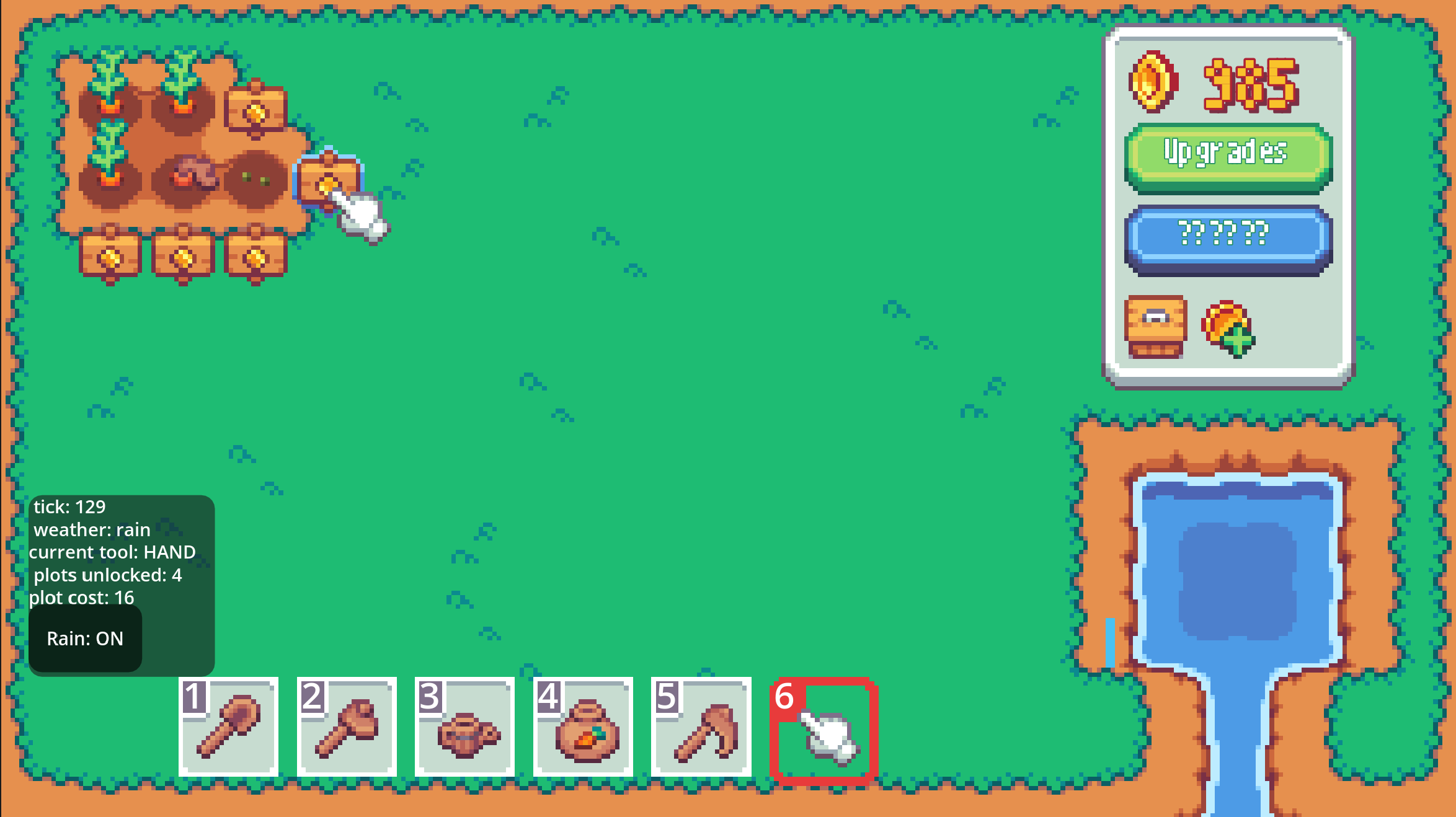
This is going to be a bit of a punch list:
- We got our dirty paws on some assets. Ash is a good pixel artist, but having to do all the art from scratch, plus build the game, plus everything else is a lot for one person. Buying some baseline assets (with the company card!) allows us to execute faster on the vision.
- We made crops grow. This might seem silly, but if you’re going to have crops, figuring out how to get them to grow over time, how to get the right image to display when they do? These are the pieces from which a game system is built.
- We made tools. Let there be a watering can, and let it sprinkle, and we saw that it was good.
- We made a tiled plot system, so that you could plant crops in specific places, and then we made it so that they could be unlocked. One of the key game loops in most incremental games is getting resource to unlock more thing so that you can get more resource to unlock more thing and so on and so forth.
- We made it rain. Both literally and figuratively. From the watering can and the sky, with effects on how the crops grow.
- We made it look a little prettier. For the screenshot. We probably shouldn’t have, but it’s our first screenshot and we’re proud of it.
Not bad for like, nine days, right?
In a traditional sprint retro usually we’d talk about three things. What went well, what didn’t, and what we might want to change next time. Sometimes this is called “start, stop, keep.” But we’re an extremely nontraditional company run by an extremely nontraditional internet soup wizard.
We will instead be doing stuff we wish we’d known, notes to future us, and what we think is coming next.
The Broth, or The Foundation of Things, or What Would I Want To Have Known Before This Sprint If I Could Have Known Them
- We’re using YouTrack as our planning tool. I like JetBrains. It’s pretty good. But it’s also very Not Jira. Coming from a mostly-Jira background, I’ve had to rapidly learn and adapt to a surprisingly different take on how a tool like this should work.
- Did you know the CAN-SPAM act requires the sender of the email to put a physical mailing address in the email? Me either, but I do now. If I had known I was going to need an address for the studio that wasn’t my address, I would have started the process of getting one earlier. (To be fair, I knew we’d need this eventually, but wanted to put it off as long as possible).
The Bread, or The Accoutrements, or Other Things That Go On The Side And Are Also Good Maybe But Aren’t Really A Meal On Their Own
- Having good idea capture hygiene is really important in a creative company. This is a pipeline I’m still working on, and probably will be forever, but lots of good ideas pop up that aren’t right for this prototype but may be for the next.
The … Look I Couldn’t Find A B-Food-Word That Worked Here, or The Things Coming Next, or That Which I Naively Believe We Might Actually Be Talking About Next Time
- We have honest-to-goodness research tickets in the next sprint covering basic engine functionality. Stuff we’ve realized we just plain need to understand better if we want to be able to use it. Making games is hard y’all.
- Starting in on the currency system. There needs to be a thing you can sell crops for, and a thing you can use to buy upgrades, and we need a currency to be able to test that.
That’s it. Soup’s done. See you next sprint.